
Legacy SaaS pricing has been relatively consistent for the last 20 years. Most application software is priced based on the number of people using it, with some variation around modules, functionality, or volume. This model worked because software was primarily a tool that people used to perform work.
AI is changing that relationship. AI moves from helping people do work to doing the work itself, making the number of people using a product a less useful measure of value. An AI agent can do an immense amount of work with just one ‘seat’ and a company can potentially accomplish more work with fewer people.
This creates a challenge for legacy companies. If customers need fewer people to accomplish the same amount of work, the traditional mechanism for expanding revenue inside an account becomes less relevant.
We believe this will drive an evolution in pricing from seats, toward pricing based on the value or outcomes.
The seat has been a remarkably effective pricing model
The legacy SaaS model is straightforward. A company hires 1,000 employees and purchases 1,000 licenses. As the company grows, it buys more licenses. As more employees use the product, the vendor captures more of the value it creates. The benefit for the customer was clear, predictable pricing that could easily be budgeted.
This model has been one of the reasons SaaS businesses have been so attractive. In addition to acquiring new customers, a software company can grow revenue within an existing account through price increases, additional products, and seat expansion. Seat expansion has historically been one of the main drivers of net dollar retention (NDR).
AI creates a problem with this model. If AI makes employees and in turn the company more productive, the customer may need fewer employees. If an AI agent can perform the work of several customer service representatives, sales development representatives, analysts, or other knowledge workers, the number of people using the software can decline even as the importance of the tool increases. Value is no longer tied to employee / seat usage.
This is already becoming apparent in customer service. Traditional customer service / helpdesk software was priced based on the number of employees using the platform. But if an AI agent can handle a significant portion of those interactions, charging based on the number of humans creates a misalignment between the vendor and the customer. Salesforce, for example, continues to have seat-based pricing across its platform while introducing usage-based pricing for Agentforce. Intercom has gone further with Fin, which is priced based on successful outcomes rather than the number of seats.
Evolution takes time and we do not think seat-based pricing will simply disappear. Seats remain simple and predictable for customers. However, the issue is that seat expansion becomes less attractive as a growth mechanism when AI is performing more of the work.
That matters for investors because many of the metrics we have historically used to evaluate software businesses were built around this model. A company growing from 1,000 employees to 1,200 employees was naturally a growing customer. Moreover, that 200 seat growth was incredibly profitable because it required no additional S&M spend. With AI, a company could increase its use of AI while reducing the number of seats.
The question becomes: if seats are no longer the best measure of value, how should companies be designing pricing models for the future?
Four approaches to software pricing
We think there are four broad pricing models emerging. We believe AI will push successful companies towards value / outcome pricing and expose risks in large incumbents.
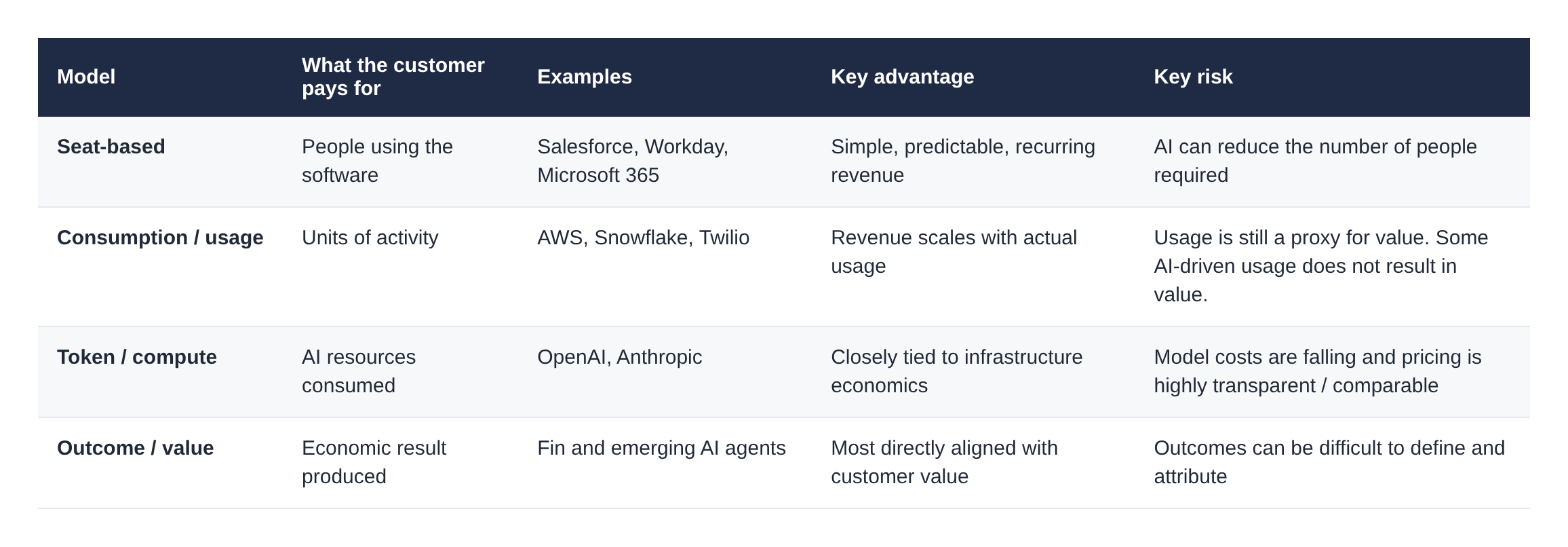
Of course, these models are not mutually exclusive. We expect many companies to use a combination of them.
A company may charge a platform fee for access to its software, a usage-based fee as activity increases, and a take rate or outcome-based fee when it directly participates in the economic value created. This can provide the predictability of recurring software revenue while allowing the company to capture more value as customer activity grows.
The more important question is not whether a company charges per seat, per transaction, or based on an outcome. It is whether its pricing model expands as the value it creates for the customer increases.
Consumption is a better pricing model, but it is still a proxy
Consumption-based pricing is not new. AWS, Snowflake, Twilio and other infrastructure companies have used variations of it for years. It works particularly well when usage is closely correlated with the value a customer receives. A company that processes more data through Snowflake or sends more messages through Twilio generally gets more value from those platforms and is willing to pay more.
AI makes this model relevant much further up the software stack. An AI agent can perform a very different amount of work depending on the task. One interaction may require a single model call. Another may involve reading documents, querying databases, calling APIs, executing multiple workflow steps, checking its work, and retrying when necessary.
Charging based on usage captures some of this difference. If technology is doing more work for a customer, the customer should pay more.
However, consumption is still a proxy for value. An AI agent might not distinguish between high-value and low-value work. Moreover, some outcomes are worth more than others but the ‘work’ required to achieve the outcome may be similar.
The more technology can directly influence an economic outcome, the less attractive activity becomes as the pricing metric.
Token pricing has a different problem
Token-based pricing is another logical model for AI, particularly at the infrastructure layer and is closely tied to consumption pricing. Model providers charge based on tokens because they are closely related to the amount of compute required to serve a request. OpenAI, Anthropic and other model providers all publish pricing based on token consumption.
For infrastructure companies, this can be an attractive model. For application companies, we think it has a more fundamental problem. Tokens measure compute, not value.
They are unusually easy to compare. Customers can look across model providers and compare the cost of a million tokens. As models improve and inference becomes cheaper, the amount of intelligence available for each dollar should continue to increase.
This creates a difficult dynamic for an application company whose pricing is directly tied to tokens. If the underlying cost of intelligence falls materially, customers will expect some portion of that benefit to accrue to them. And if application companies can switch between models (including open source), the cost of the underlying intelligence becomes increasingly transparent.
We think token pricing will remain important at the infrastructure layer, but we believe this model has significant risk for application vendors.
The most attractive model is pricing against value
The logical endpoint is pricing based on the value created by AI. We believe customers do not ultimately want seats, tokens, or AI conversations. They want outcomes. Customers want issues resolved. They want invoices collected, qualified leads, contracts reviewed, claims processed, and shipments delivered.
We think verticalization may be particularly important to this evolution. Pricing based on value requires a company to understand not only what work its software performs, but what that work is worth to the customer. This is often easier in a vertical market, where companies can become deeply embedded in a specific workflow and understand the underlying economics.
A vertical company may be able to measure whether a claim was processed, a patient was seen, a payment was collected, or a transaction was completed. The more deeply software is embedded in the workflow, the easier it can become to move beyond charging for access and toward pricing based on the value created.
Emora Health, one of our companies, is a good example of how software can capture value beyond a traditional seat-based model in the healthcare vertical.. Rather than charging based on the number of therapists using the platform, Emora participates in the economic activity it enables by connecting patients, providers, and payors. As AI allows software to perform more of the underlying work, we believe more application companies will have an opportunity to align pricing with the value they create rather than simply the number of people using the software.
This is attractive because it aligns the vendor and the customer. If the technology creates more value, the vendor gets paid more. As the customer grows, the vendor grows alongside it. In addition, pricing to value allows the company to participate in budgets that were previously allocated to labor or services rather than software.
The market is starting to differentiate between pricing models
There are already signs that public markets are beginning to distinguish between different business models.
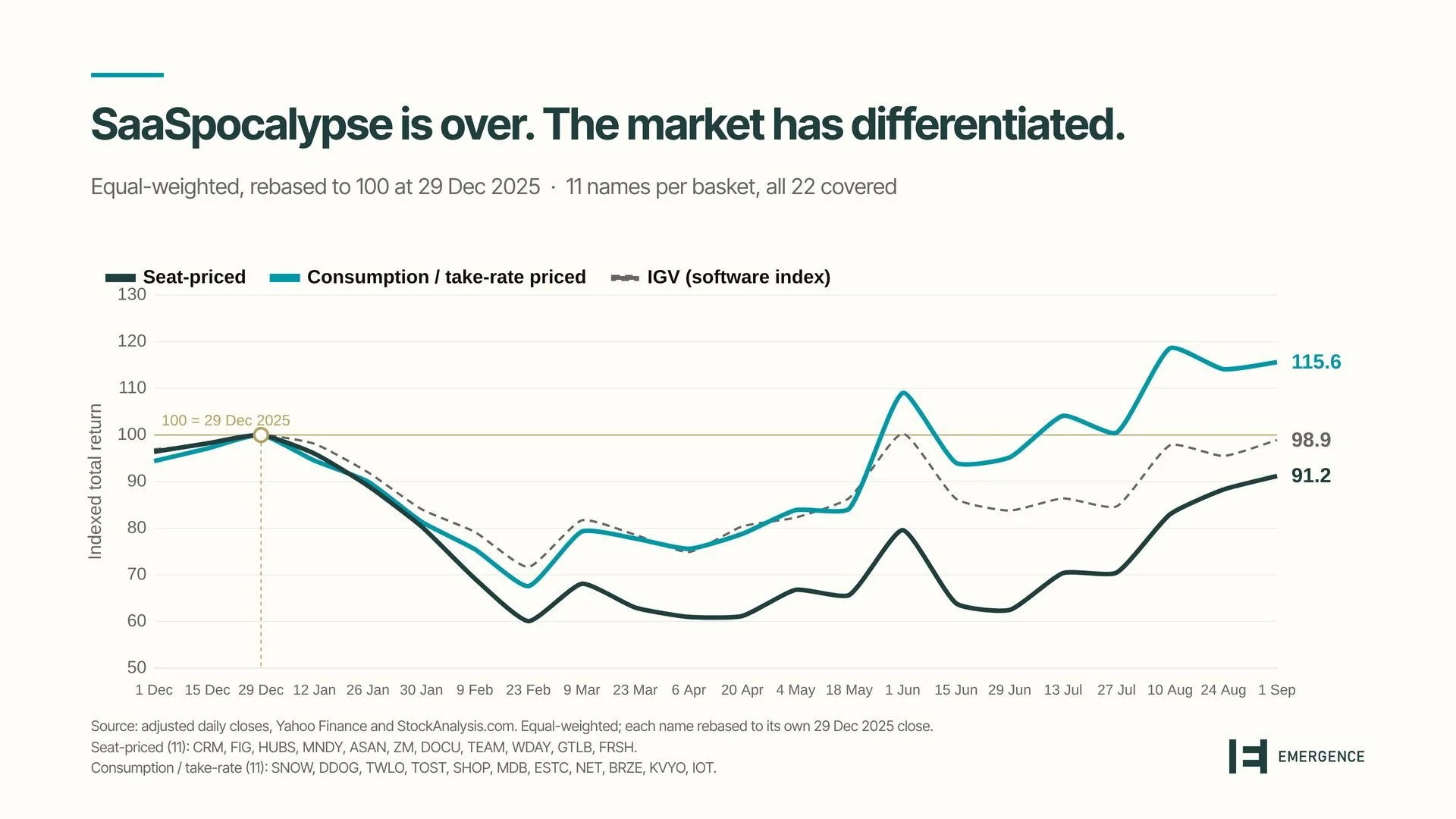
The market is increasingly distinguishing between businesses based on what drives revenue growth. In a seat-based model, growth is tied to the number of users; in a consumption or take-rate model, it can scale with the economic activity flowing through the platform. This distinction becomes more important as companies grow revenue without adding headcount, making it increasingly important for software companies to capture the economic activity they enable rather than simply the number of people using the product.
Outcome pricing has its own challenges
We do not think every AI application will move to outcome-based pricing. The biggest challenge is that outcomes can be difficult to define and attribute.
An AI sales agent may identify a lead, but the customer ultimately closes the deal. An AI recruiting platform may source a candidate, but the customer makes the hiring decision. An AI marketing platform may contribute to revenue without being able to determine exactly how much revenue it created.
Outcome pricing also transfers more risk to the vendor. A seat-based software company gets paid whether or not the customer uses the product effectively. An outcome-based company only gets paid when the desired result occurs.
That makes outcome pricing particularly attractive when the outcome is measurable and the technology controls a large portion of the workflow.
We expect the market to support all four models for a long time. The important question is not whether every company should move to outcome pricing. It is whether the pricing model gets better aligned with the value the product creates as AI changes the underlying workflow.
How this shapes our investing
At Strata, we increasingly think about pricing as part of the underlying business model rather than simply a monetization decision.
We look for companies where:
The company sits within a mission-critical workflow and has high usage and engagement.
The product is performing work otherwise done by humans.
There is a clear and measurable ROI that supports usage- or outcome-based pricing.
The company can expand beyond the IT budget into multiple areas of services or labor spend.
AI increases the amount of value the product creates rather than simply reducing the cost of delivering the same product.
Account values can grow as the customer becomes more successful, even if the customer's headcount does not.
When a company's pricing is tied to the economic activity of its customers, the growth of the underlying market becomes increasingly important. A company with a take-rate model can benefit from the growth of the market it serves. Selecting growing markets therefore becomes even more important when the company's revenue is directly tied to its customer’s success.
The most attractive businesses can benefit from multiple layers of compounding: growth in the number of customers, growth in share of wallet, and growth in the underlying economic activity of those customers.
We believe that the market (including public market investors and acquirors) will see two companies with similar products but very different long-term economics depending on how they charge. A company whose pricing scales with the value created by AI may have significantly more pricing power than one whose pricing is tied to a metric that AI is making less relevant. Moreover, the best AI application businesses will increasingly capture spend outside of traditional software budgets.
Looking ahead
AI is changing more than the product that companies sell. It is changing the economic relationship between a technology company and its customers.
For the last 20 years, the primary unit of legacy software pricing was the seat. In many cases, the connection between seat and ROI was fuzzy.
The increase in the capabilities of AI and the resulting shift to value / outcomes based pricing will unlock massive potential TAM, but there will be winners and losers. Companies who fail to adapt their products and pricing will be stuck behind. AI-native companies have an incredible opportunity to capture far more value today, but their products must deliver accurately and consistently.
We believe this creates significant risk for legacy software companies and abundant opportunity for AI native companies. Businesses that are heavily dependent on seat expansion may need to rethink how they monetize as their customers become more productive with fewer people. At the same time, companies that can automate labor, capture more of the workflow, and price against the value they create have an opportunity to increase both their addressable market and their share of customer spend.